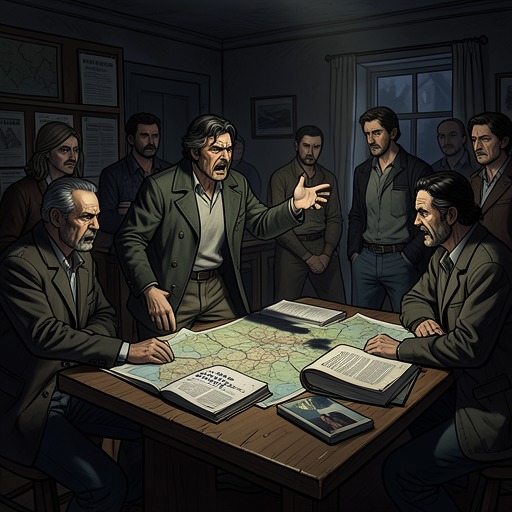
Ernst Pul
All the Old KnivesErnst Pul is the Vienna station’s direct link to Austrian counterparts, a role grounded in both his background and his ability to work across institutional boundaries. During the airline threat, his confident assessments test the team’s assumptions; as the crisis develops, he also helps turn guarded discussion into practical cooperation with Austria.
Identity and Background
Ernst was born in Graz and moved to Atlanta, Georgia, at the age of ten with his academic parents. The move left him with what the narrator describes as an unusual blend of Austrian and Southern accents. He wears Swiss banker’s suits and retains an Austrian haughtiness that decades in the American South have not diminished. These traits are not merely personal eccentricities: they help charm the station’s counterparts in the Bundesamt für Verfassungsschutz, making him the Americans’ direct go-between with the Austrians.
His function places him between agencies as well as between national cultures. He is introduced among the staff summoned to Vick’s office after a Damascus station message warns of a possible airline-related event within seventy-two hours, on a flight bound for Austria or Germany. The warning names Aslim Taslam, while leaving the departure point uncertain. Ernst’s Austrian ties make the question of whether the threat concerns Austria his to address, but his answers are shaped by an effort to infer what the group might want, not simply by national loyalty.
Assessing the Threat
Ernst initially rejects Austria as a plausible target, while allowing that Germany might be more likely. He compares the countries’ possible value to the group: Austria has about a hundred troops in Afghanistan, against Germany’s more than four thousand; Austrian prisons hold relatively few militants, while Germany holds many more; and he doubts the group needs money because Tehran is already supporting it. His reasoning is brisk and categorical, delivered with the air of someone convinced that the available facts point in one direction.
The narrator challenges the national framing. If the purpose is to exert pressure on Europe, the group could choose the softest target and make demands of any European country without landing in Frankfurt or Berlin. Vick recognizes the argument as a good one. The exchange shows both Ernst’s strengths and the limits of a confident specialist’s first model: he identifies concrete differences between Austria and Germany, but the possibility of a broader European strategy changes what those differences mean.
Ernst’s skepticism also has a history. He recalls that in 2004 TRIPWIRE reported an al-Qaeda cell in Salzburg, prompting the station and the Interior Ministry to spend time trying to get a warehouse stormed; the warehouse was empty. On that basis, he estimates an eighty-percent chance that the new report is another false story, though he says the station can keep watching it. His caution is therefore more than reflexive dismissal: he remembers the cost of acting on an unverified source, even as a new Europol message gives the warning a possible connection to Ilyas Shishani, reportedly in Barcelona after arriving from Jordan.
Vienna Station and the Plane
As the crisis escalates, Ernst’s professional position brings him into the practical decisions surrounding the aircraft. He reports that EKO Cobra, Austria’s assault team, is on standby, a fact that does not reassure the Americans. The team’s readiness makes the prospect of an assault feel more immediate, while the station still lacks certainty about the hijackers’ intentions and the safest course of action.
When the station considers how a camera could have been attached to the plane’s underside, Ernst points to security at Amman airport. A baggage loader, he reasons, could have attached a remotely operated camera to the hull. The suggestion offers a concrete mechanism for the surveillance device, though the staff have not yet seen it: Vick asks how it could have been installed, and Bill notes that Austrian and television cameras have watched the aircraft without detecting anything unusual. Ernst’s answer is an operational hypothesis, not confirmation of who placed the camera or how the hijackers obtained it.
The camera changes the stakes of information-sharing. Ahmed Najjar, a Lebanese-passport traveler who is secretly a courier for the Americans, has sent a message describing the passengers, the attackers, dwindling water, and his suggestion of a rear-undercarriage assault. The Austrians do not know about Ahmed, and the Americans have been keeping his identity quiet. When Celia argues that they may need to share information if they hope to get anyone out alive, Vick raises the concern that the Interior Ministry personnel have not been vetted.
Cooperation and Narrative Role
Ernst’s conduct at this point complicates his earlier certainty that Austria is an unlikely target. He does not dismiss the security risk or insist that the Americans act alone. After Vick asks for opinions, Ernst sighs and agrees to bring the Austrians into the effort. Vick tells him to make the call; Ernst looks at Celia, takes out his phone, and leaves the office. His action marks a shift from assessing whether Austria is a likely object of the threat to accepting that Austrian cooperation may be necessary to respond to it.
The available scenes present Ernst chiefly through professional judgment: the cultural familiarity that makes him a liaison, his forceful reading of motives, his memory of a costly false lead, and his eventual participation in sharing information. His confidence is not infallibility. The team’s discussion revises his initial national calculation, while the hidden identity of Ahmed makes cooperation difficult even when the operational need is clear. Ernst’s role is to carry that tension across the institutional boundary: he knows the Austrian system well enough to work with it, but the crisis forces the station to decide how much of its own information it can safely entrust to that system.